Do You Need Council Approval to Replace a Garage Door in Sydney?
This is the question we get asked halfway through a quote, usually in a tone that suggests the person is hoping the answer is no. Most of the time it is. But the exceptions in Sydney are common enough — and expensive enough to get wrong — that it is worth knowing which side of the line your property sits on before you order a door rather than after it arrives on a truck.
The short version: a straight like-for-like replacement of an existing garage door is generally exempt development in NSW, which means no approval at all. Three things break that. Changing the size of the opening. Heritage. Bush fire prone land. Any one of them, and you are in a different process.
The general rule: like-for-like is usually exempt
NSW planning law has a category called exempt development — work so minor it needs no approval from anyone, provided it meets a set of standards. The State Environmental Planning Policy that governs it includes a subdivision covering minor external building alterations, and that subdivision expressly lists the replacement of an external door as specified development.
Worth being precise here, because plenty of industry websites are not: the clause says "a door". It does not say "garage door" anywhere in the instrument. Reading a garage door into it is a reasonable interpretation — the list is expressly non-exhaustive, and there is a second limb covering remedial work necessary to repair or maintain a building — but you will not find the words "garage door" in the planning instrument, and anyone telling you the law specifically blesses garage doors is overstating it.
The one thing that voids it: changing the opening
This is the decisive standard and it is unusually clear. To stay exempt, the work must not comprise the making of, or an alteration to the size of, any opening in a wall or roof. Same-size replacement is fine. Widening the opening by 200mm to fit a modern car is not — it does not matter how minor it looks or how good the reason is.
It catches people constantly, because widening is exactly what a lot of owners want. The original opening was sized for a 1960s car, the current one has mirrors, and the obvious fix is to take out a bit of brickwork. The moment you do, you leave exempt development entirely and land in either complying development under the Housing Alterations Code or a development application to council.
If you are weighing whether to widen at all, it is worth reading our note on choosing between door types in garage door installation and replacement first — in a lot of tight Sydney garages a different door type solves the clearance problem without touching the opening.
Heritage: the trap that catches most of inner Sydney
Here is the part that surprises people. The exempt development subdivision for minor external alterations does not apply to work on or in a heritage item, a draft heritage item, a heritage conservation area, or a draft heritage conservation area. That is a four-way bar, and it is broader than most owners assume — it catches locally-listed items and whole conservation areas, not just the famous State-listed buildings.
Complying development does not rescue you either on a heritage item: a CDC is unavailable on land identified as a heritage item by a planning instrument, which captures local council listings, not only the State Heritage Register.
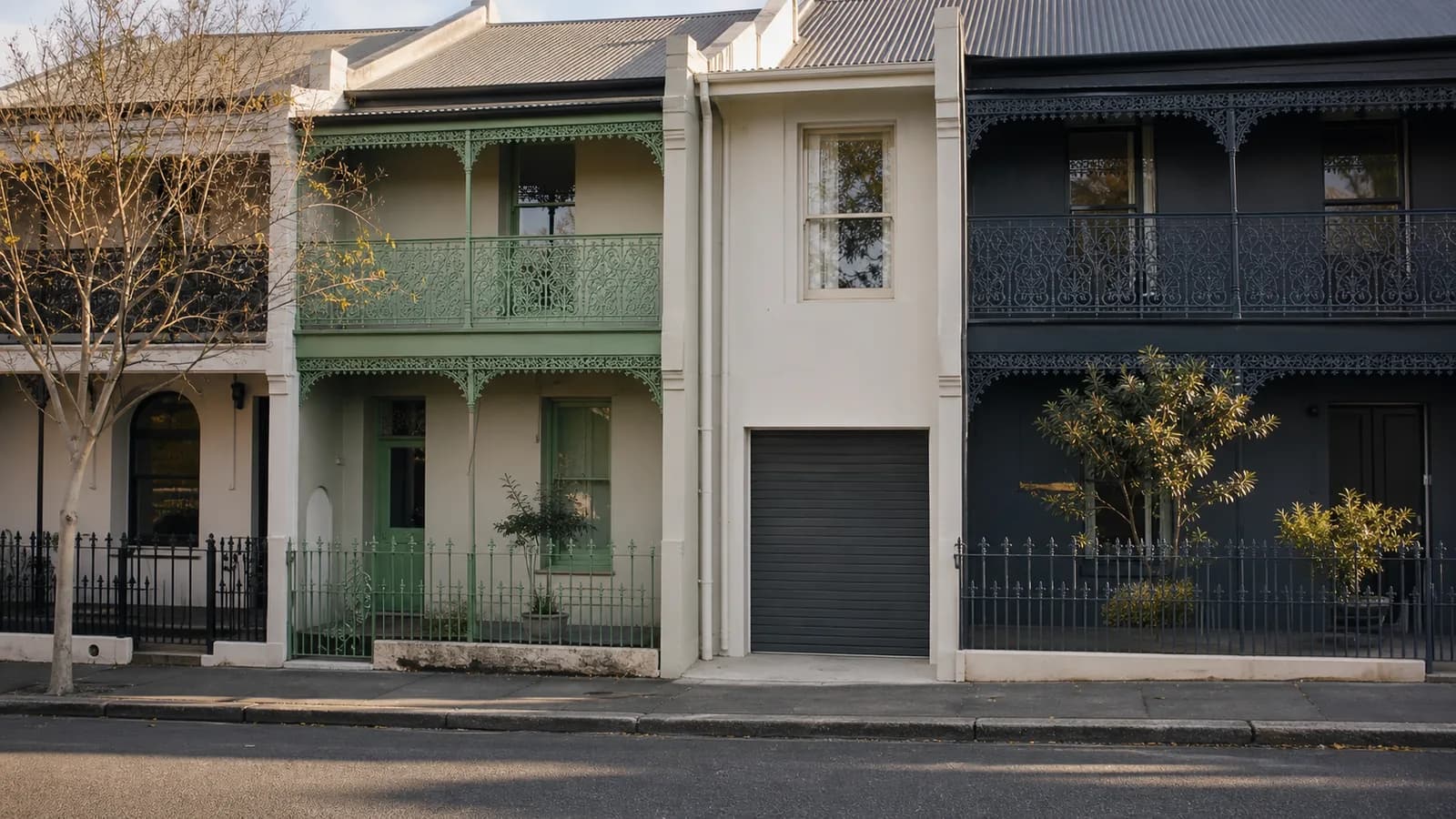
For a property inside a conservation area rather than an item, there is a narrow path for detached outbuildings — but the Housing Alterations Code separately provides that work must not be to a wall facing the primary road. A garage door almost always sits on exactly that wall. So for a street-facing garage door in a conservation area, the practical answer is: neither exempt nor complying. It needs development consent from council.
This matters far more in Sydney than it would in most Australian cities, because so much of the inner ring is conservation area — the terraces of Surry Hills, Paddington, Glebe, Woollahra and Balmain among many others. If you own a terrace with a street-facing door, assume heritage applies until you have checked.
The minor-works shortcut — and its catch
Every NSW council's local environmental plan carries a standard heritage clause, and it has a useful escape valve: consent is not required if you notify the council, and the council advises you in writing beforehand that it is satisfied the work is minor or is maintenance and would not adversely affect heritage significance.
Note the sequence, because it is the whole point. The advice has to come before work starts. Woollahra Council states it plainly in its own guidance: the clause cannot be applied retrospectively. Doing the work and asking afterwards is not an option that exists.
Bush fire prone land: the exemption switches off
The third exception is the one almost nobody knows. Read the exempt development clause carefully and the door replacement provision carries a parenthetical: it covers the replacement of an external window, glazing areas or a door — other than those on bush fire prone land.
So on bush fire prone land, the exempt pathway for a door replacement is switched off by the words of the clause itself. This is not obscure in Sydney: it affects the bushland interface right through the Hills District, the upper North Shore, Lane Cove and the northern end of the Northern Beaches. A job that would need no approval three streets away may need one here.
In a strata building, planning is not your only problem
If your garage door is in an apartment building, there is a second approval question sitting on top of the planning one, and it is usually the harder of the two. In most NSW schemes an external garage door is common property, which means replacing it is not a decision an individual owner gets to make.
Work that changes the external appearance of a lot is excluded from both the cosmetic-work and the minor-renovations provisions of the strata legislation, which points to a special resolution of the owners corporation. Strata committee sign-off on its own is generally not enough. Because it turns on your registered strata plan and by-laws, check with your strata manager before you commit to anything — and see our strata and basement car park doors page for how that process usually runs.
How to check your own property in ten minutes
- Search your address on the NSW Planning Portal Spatial Viewer and look at the planning layers for your lot.
- Search the State Heritage Inventory, which covers more than 30,000 records including items councils manage through their local environmental plans — not just State-listed ones.
- Order a planning certificate (a section 10.7 certificate) from your council. It costs a modest fee and is the definitive answer rather than an indication.
- Ask your council's duty planner directly. For a question this specific, a five-minute phone call usually beats an afternoon of reading.
And if it turns out the answer is complicated, that is genuinely worth knowing before the door is ordered rather than after. We raise the approval position as part of quoting, because an approval problem discovered on installation day is the most expensive kind.